
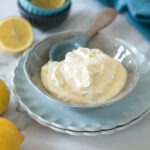
Homemade Mascarpone Cheese Recipe (2 Ingredients)
Make rich, creamy homemade mascarpone cheese with just 2 ingredients and 10 minutes of prep. Ready to use after an overnight chill.
Serving: 16
Calories: 108kcal
Ingredients
- 500 g fresh whipping cream
- 1 tablespoon fresh lemon juice
Instructions
- Place the whipping cream in a large saucepan and stir over low heat for about 3 minutes, or until reaches 185°F (85°C).
- Add in the lemon juice, and continue to stir over low heat for 2-3 minutes, then remove the pan from the heat and allow the cream cool.
- Place a sieve lined with a tea towel or 3-4 layers of cheesecloth over a bowl. Pour the cream through the sieve, only few drops of the cream should be able to reach the base of the bowl, if it's more, use 2 layers of tea towel to prevent it.
- Cover the cream and place in the refrigerator for 24 hours. The mascarpone cheese is ready when it reaches a rich and creamy texture.
Notes
How much mascarpone does this recipe make?
About 300 g, from 500 g of cream. Yield varies with the fat content of your cream and how long you strain it. To get 500g mascarpone, use around 800 g of cream.
Can I double the recipe?
Yes. Keep the ratio of 1 tablespoon of lemon juice per 500 g of cream, use a wide pan so the cream heats evenly, and give it a bit longer to come up to temperature.
EXTRA NOTES
- Temperature matters most. Under 185°F / 85°C, the cream won't set properly. Over it, the cheese turns grainy.
- Cream: use fresh pasteurised cream with 32–36% fat. Ultra-pasteurised works but sets softer and may need extra time.
- Acid swaps: 2 g citric acid dissolved in 1 tablespoon lukewarm water, 1 tablespoon white wine vinegar, or 1 tablespoon lime juice.
- Too thick? Stir in a spoonful of cream. Too thin? Strain for another 6–12 hours.
- Whey: save the liquid that drains off for bread, pizza dough or pancakes.
- Scaling up: for 500 g of mascarpone, start with about 800 g of cream.
Did you try this recipe? Tag @thepetitecook or use the hashtag #thepetitecook - Looking at your pictures makes my day!
Nutrition
Calories: 108kcal | Carbohydrates: 1g | Protein: 1g | Fat: 12g | Saturated Fat: 7g | Polyunsaturated Fat: 1g | Monounsaturated Fat: 3g | Cholesterol: 43mg | Sodium: 12mg | Potassium: 24mg | Fiber: 1g | Sugar: 1g | Vitamin A: 459IU | Vitamin C: 1mg | Calcium: 20mg | Iron: 1mg
The information shown is an estimate provided by an online nutrition calculator. It should not be considered a substitute for a professional nutritionist’s advice.